

Rainy weather: boon or curse?
Deepak Aryal and Bishnu Bhatta
The monsoon rain has broken its previous record this year both in volume and the time of commence. Paddy farmers, who would look up at the sky in the hope of rain that would soften the tough surface of the land, were now transplanting the paddy seedlings in the curd like soil. They did not have to operate the deep tube dwell this year, nor was any dispute concerning the turn of irrigation from the artery size canal heard. In addition, many riverside towns and renowned holy spots in the West were reported to have dissolved themselves in the whirl of flooding. On the other hand, the southern sloping geographical structure with the great snow piled Himalayan range at the top in the North naturally accelerates the current of streams and rivers. An increase in volume of water in the rivers of
Children to be concerned with natural science
We think the school children should be acquainted with the phenomena in the natural world. Keeping this in mind, we managed a bus trip to a river with 34 children and three teachers. It had been raining almost for a week. Farmers had recently finished transplanting the paddy seedlings. So the fields looked pale green. Even streams that flow through them were about to overflow their banks. Due to summer vacations the school was closed for ten days. We had fixed the date for the trip beforehand. Some parents seemed reluctant to send their children on the trip in such a rainy weather concerning their safety, but they agreed when we convinced them of our well preparation and noble objectives.
Enthusiasm for outdoor activities
All the children came to school at 11 a.m. in their school uniforms. They had a little bag that contained a note book, a pencil and a water bottle. Some of them also had some homemade snacks. The children were busy talking to each other as they had come together again after several days. They were expressing themselves in a full range. The children’s weather beaten faces suggested that they had been out in the sun since the vacation started. We could see some children scratching the heat rash whereas others were showing their friends the bruises in the legs and fingers caused by the mud. Nevertheless, their eyes were twinkling with merriment, for it was the first time they had ever been on a bus trip to a riverside in the rainy season. All of us boarded a mini bus from the school gate which then moved towards our destination: The Narayani River, about 12 kilometers north of the school.
Too much is dangerous
The children looked fully alert during the drive as they were having a new experience. Whenever we came across a flooded stream, they would give a loud shout of joy. At some point on the way a stream was overflowing the road. “Why is there no bridge, Miss?” was Barun’s question. Raising her voice the teacher said “Too much is always dangerous.” She asked “What happens if you eat too much? The digestive tract cannot accommodate your food; as a result, you will suffer from nausea and vomiting. So is the case of flooding. There is a bridge but the volume of water increased so much that it could not digest it”. Thus, the teacher tried to enlighten the children about the cause of flooding.
Groups of boys with fishing nets in their hands could be seen in the flooded stream. Some of them had sticks or spears. It was the first time they had seen fishing in the flood. “They seem to have caught big fish”, Sagun showed her curiosity pointing to a group,” where do they come from?” “All the waters flow down the south and pour into the
Like a spider’s web
By then the bus entered the
Life is a line itself
The bus stopped at Pokhara Buspark, Narayangarh. We got off the bus and asked the children to walk in line. “Excuse me, Miss”, Sanjaya Gurung said, “Why do you always get us to be in line whenever we are supposed to perform some collective work? Why don’t you let us walk free?” The teacher looked perplexed. “Do you see, Sanjay,” she spoke lovingly, “the buildings on either side of the street are in line, the motor vehicles are moving in line, the electric poles, the dividers on the roads, the bricks in the wall, the seats on the bus, the mountain range, the snow line, what more? Almost everything is in line.” She then showed the children her note book and said that her writing was also in line. She said,” If I escape the line, no one would like to read my writing.”
Diversions of Nature
Eventually, we arrived at the river side temple at the backyard which overlooks the beautiful landscape of the green hills, from which it seems the
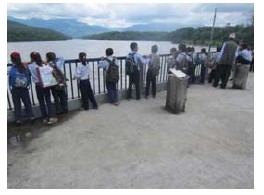
Size does not matter but height
Then the teachers asked them to sit down on the floor and rolled out a map of Asia and asked to find
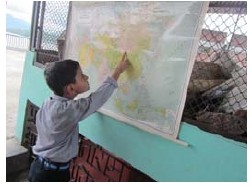
Afterwards the teacher showed a big map of
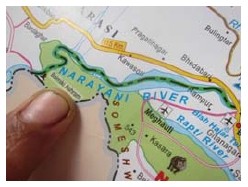
The Narayani exports soil
We spent about two hours in the temple premises and then decided to make the children feel the river water themselves. They walked to the beach, which was sticky and damp as the river was gradually receding. In its middle, a tower erects out of the main stream. Some of the children liked to have the river view from its top. They climbed the pillar since there was no ladder. From the tower they enjoyed the surging waves of the river. “They look in haste, where are they rushing?” Shonik personified the waves as runners. “Their destination is the Bay of Bengal, India,” the teacher spoke, “They are returning where they came from. I mean the monsoon clouds from the Bay of Bengal bring rain to Nepal in the rainy season that causes floods.”
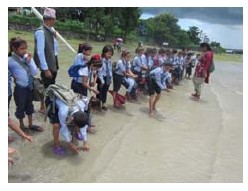
Then the children were asked to stand in line on the water up to their knees. “Oh, it is so cold!” Ashwin exclaimed. The teachers got them to examine the water closely. The children held some water in the palm of their hands and brought it close to their eyes. “It’s full of mud”, they all shouted. “Is there sand or anything else?”—“No more sand, but there are thinner particles of soil that have dissolved in water. Maybe it is top soil about which we studied in our science class.”
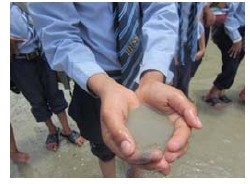
While talking about long-term soil formation, one of the teachers mentioned “It means we are ‘exporting’ tons of fertile soil to India through the rivers for free. Am I right?” The children all nodded. “Is it good?”—“No, but it’s inevitable. “It’s not wise to take it as our fate,” the teacher said, “We must take preventive measures to reduce the loss. Can you suggest any?”—“Planting trees, growing grass on the hill side and river banks, making supporting walls on either side of the river can prevent soil erosion and landslides.” It was the last activity of the trip. Finally, the teachers asked their pupils to tell the uses of river water: “Sail boats.”—“Generate electricity.”—“Operate water mills.”—“Irrigate the fields.”— “Keep fish.” …
Nature – a perfect classroom
The trip has certainly broadened the horizons of the children’s knowledge and experience. It was a great opportunity for them to get into deep conversation with one another about what they just saw. During the five hour outdoor stay they were also able to attend to most of their subjects except for mathematics. The teachers, side by side, seem tactful to exploit the situation for the achievement of predetermined teaching objectives. If the tactful attitudes on the part of teachers’ proceeds like this, I’m sure; the days are not far from us when nature as a whole is unanimously accepted as a well-equipped perfect classroom.
By: Matthew Bell, Premedical Students Saint Mary Collage, USA
By far, the most common phrase our group would say while walking the streets of Dhulikhel and Khadichaur, bowing slightly with our palms together every few steps to give and receive a smiling ‘Namaste’ to the local villagers, was, “How are we ever going to explain this place to everybody back home?” To be honest, the answer to that question still eludes me, and I doubt I will ever be able to adequately describe that peaceful riverside village and the people who changed my perspective on life. With every American accented word of broken Nepali spoken to the locals, it became more and more difficult to tell whether the villagers or myself were more excited about our simplest of words exchanged. And with each passing meal of daal bhat and dudh chia, the shrinking of my waistline could not match the expansion of my heart for this place that is beyond explanation.
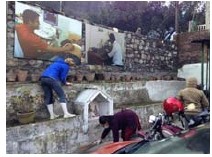
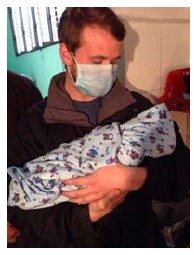
There were also many times during my experience at the Sindhu Sadabahar public health center in Khadichaur that I said to myself with certainty, “this is real medicine”. These nurses and lone doctor living alongside us in the simplest of living arrangements are the manifestations of what I have only been able to imagine in my mind’s eye of what a medical professional should resemble. I have never seen a more willful and complete giving of oneself than in these medical workers, completely devoid of any sense of self entitlement. This is why I was more than happy to return the favor of their lessons when we began to refurbish the outside of their hospital. After weeks of being back in America, my hands have finally healed from the scrapes due to broken brick being sealed by plaster, but after hours of toiling in the sun, I still feel a greater need to do more work than revel in the work I have completed.
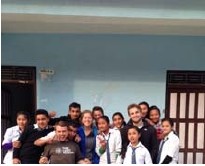
This feeling of restlessness was only magnified after spending weeks with the local schoolchildren, teaching them different health subjects such as tobacco, drugs, and alcohol. The only way to aptly encompass being enveloped by the communal love that only children have perfected is how Dorothy Day explains, “We have all known the long loneliness and we have learned that the only solution is love and that love comes with community”. I found this to be especially true in the weeks I spent many hours interacting with the local children in Dhulikhel and Khadichaur. Having never travelled to a place in the world where white skin is extensively outside the norm, I experienced, albeit only an ignorant fraction, of what it must feel like to be a racial minority in the United States, but excluding any of the negative corollaries. Although my presence as a white American was palpable at all times walking around Nepal, this was only magnified in the presence of the children, but lacking any sort of prejudiced or bigoted filter with which many people view the world. My skin, voice, and mannerisms were not seen as a stark contrast to any supposed cultural construct that was unwelcomed, but rather embraced and celebrated solely because I was, in fact, so intriguingly different.
I will never be able to do justice with simple words what I saw, felt, heard, tasted, and lived in that fleeting month I spent in the most beautiful place I have ever experienced. It is an experience that can never be put into words, and I hope that it never will be, because this is something that I would never want to cheat a person from knowing for his or herself.
